
Copilot Cowork: The Meter is Running

Copilot Cowork Is Generally Available: What It Means for AI Adoption and Cost Planning
Last week, Microsoft announced the general availability of Copilot Cowork after three months in Frontier preview. According to Microsoft, more than half of the Fortune 500 used Cowork during preview, with adoption from companies including Accenture, Capital Group, Koch, Zurich Insurance, and others.
Read the announcement from Microsoft here.
What Is Copilot Cowork?
Copilot Cowork is designed for complex, long-running, multi-tool tasks—not just quick prompts. The goal is to complete work end to end, while staying grounded in the organization’s data and controls. Microsoft describes Cowork around five core pillars:
Cloud‑hosted execution (secure, continues running even if your device is off)
Work IQ grounding in your organization’s systems
Enterprise‑grade security & compliance
Multi‑model design (choose the right model per task)
Lower cost through efficient runtime and model selection
Cowork competes directly with the widely discussed Claude Cowork. The two offerings appear to overlap significantly in functionality, but important differences remain—especially around access to organizational data, Microsoft 365 integration, and enterprise controls.
Microsoft testing showed Cowork to be 30–40% cheaper per prompt than Claude Cowork with the Microsoft 365 connector. Interestingly, Copilot Cowork uses Anthropic models—Opus 4.8 and Sonnet 4.6—by default. In that sense, Anthropic still benefits if Microsoft successfully drives Cowork adoption.
The emphasis on savings through better model selection and orchestration points to a broader market reality: the AI industry is getting more serious about inference costs.
The general availability release also includes several notable updates:
Cowork toggle inside the Microsoft 365 Copilot app
New partner plugins (e.g., Enosix, Harvey, Miro, Morningstar, S&P Global Energy)
More plugins coming soon (Adobe, Atlassian, Box, Canva, Databricks, etc.)
Dynamics 365 and Fabric integration
Browser-based execution through Microsoft Edge
Expanded security and compliance capabilities, including audit logs, DSPM, eDiscovery, IRM, DLM, and Communication Compliance; DLP is coming soon
The Meter Is Running
Copilot Cowork reflects a new phase of AI adoption: one where the true cost of inference is becoming more visible in pricing. Consumption is metered from the start. To use Cowork, users need a Microsoft 365 Copilot license and then pay for usage through Copilot Credits. Task cost depends on several factors:
Model used
Context retrieval
Tool calls
Runtime
Microsoft provides a cost-modeling spreadsheet and organizes planning around three task types—light, medium, and heavy—plus four user personas to help organizations forecast spend.
What Is a Copilot Credit?
Usage of frontier models through API calls is typically measured in tokens. Microsoft uses the term “Credits,” which appears to be a higher-level billing unit derived from underlying model usage. The largest component of a Credit’s cost is likely token consumption, but Microsoft has not published a direct one-to-one mapping between Credits and tokens. I wrote about the economics of token consumption in my recent article: When the tokens run out.
The MSRP price of a Copilot Credit is $0.01 when purchased through a pay-as-you-go plan. The precise orchestration and usage of the underlying large language model are not visible. However, based on public API pricing for Opus 4.8 and Sonnet 4.6, one Copilot Credit likely represents several thousand underlying model tokens: Plans & Pricing | Claude by Anthropic.
In addition to pay-as-you-go pricing, Microsoft is offering discounts of up to 20% for organizations that pre-purchase Credits in bulk. The largest discounts appear to require very large commitments, potentially in the millions of dollars.
How Many Copilot Credits Do I Need?
Estimating Copilot Credit consumption is not much easier than forecasting token usage. The answer is still: “it depends.” That said, Microsoft has made a useful effort to help customers plan ahead by publishing guidance and a cost-estimation spreadsheet.
The guidance is built around three main factors: user persona, task type, and user count. In practical terms, organizations need to estimate how many people fit each persona and how often they will run light, medium, or heavy tasks.
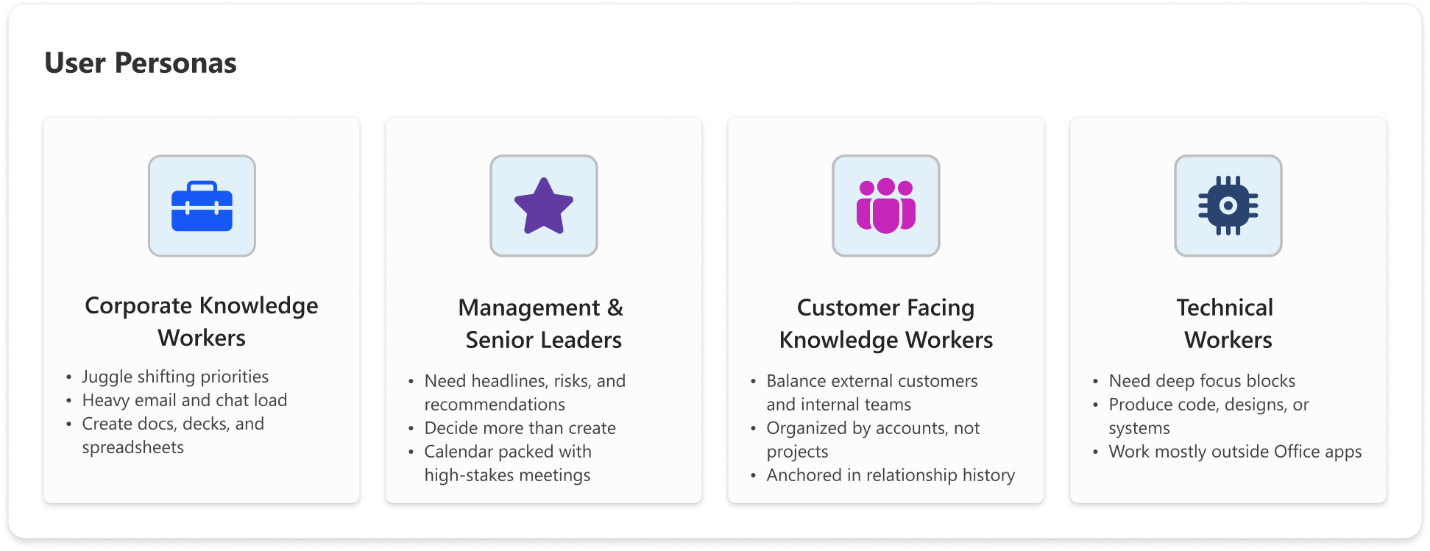
Credit: Microsoft
Tasks are described qualitatively in three categories:
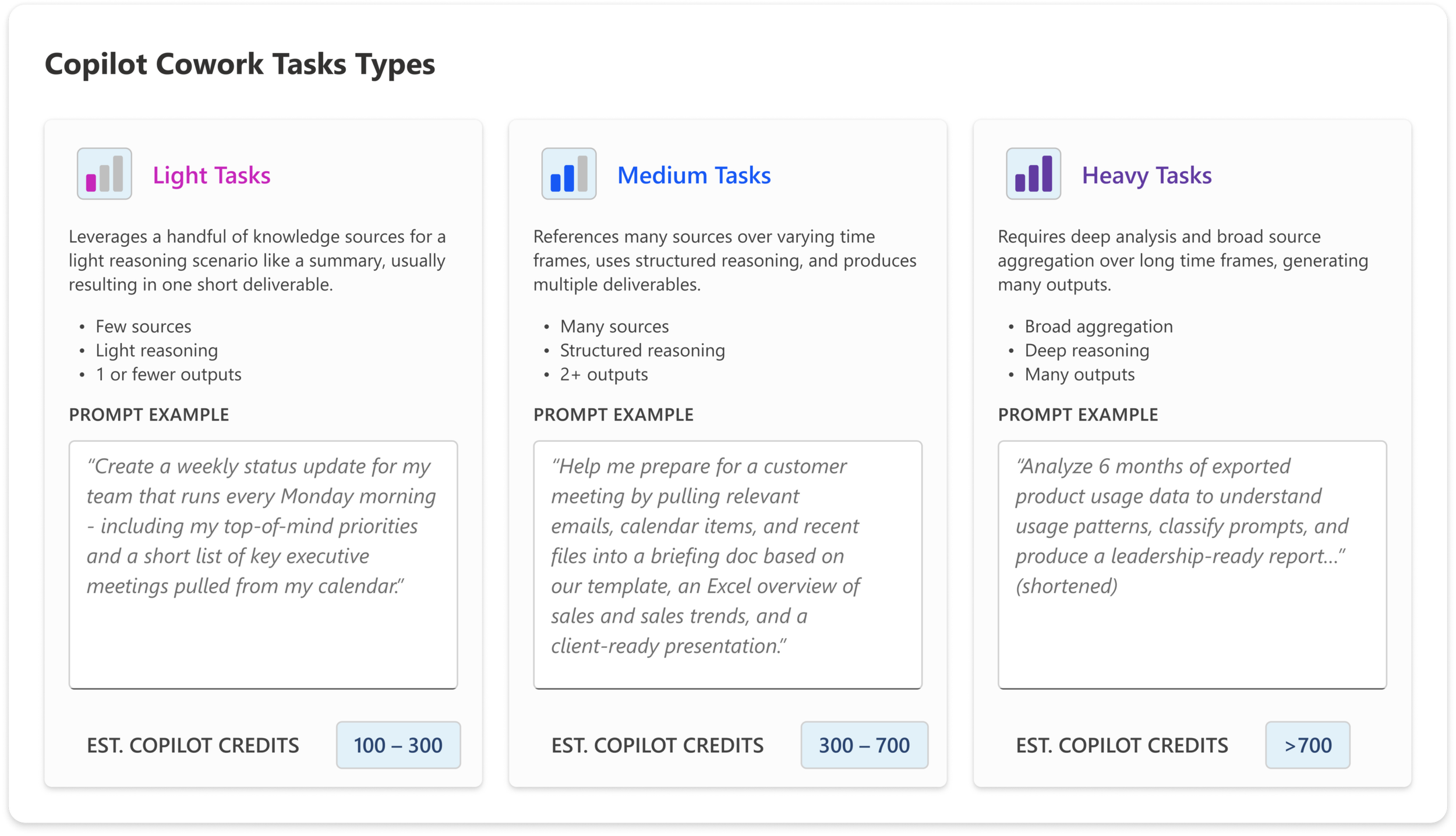
Credit: Microsoft
Translated into rough cost ranges:
Light tasks will cost $1.00 to $3.00
Medium tasks will cost $3.00 to $7.00
Heavy tasks will cost $7.00 or more
Microsoft’s Cowork Estimator can help organizations run their own estimates:
Conclusion
This announcement will almost certainly attract criticism. It would be easy to frame metered pricing as Microsoft simply “jacking up prices.” But I think the more important story is different.
When I founded Placid Works in the era of AI adoption, I knew we were already dealing with plenty of hype and unsustainable assumptions. I would rather operate in an economic reality that reflects the true cost of what we are doing. If using an AI tool with a large language model to complete a medium-level agentic task costs $3.00 to $7.00, I would rather know that now and plan accordingly. The alternatives are likely worse.
Large language models and generative AI are incredible innovations. There is already enormous utility and a wide range of realistic applications. But AI is not the right fit for every use case.
I believe the economic reality of spending a few dollars per agentic task will help organizations focus on the scenarios where AI creates real value… I think this will help AI adoption in the long run.